It’s a new year, and a new gardening season is beginning! As we push through these dark winter days, nothing feels more comforting than a steaming cup of tea and a stack of seed catalogs spread out before you like a treasure map.
My catalogs are already looking dog-eared from constant browsing and dreaming. For me, that’s key, as I use seed catalogs for garden inspiration – not just shopping lists (although I find myself wanting everything I see).

Some seed catalogs are quite educational in their presentation, providing a wealth of helpful information about each variety. Others force you to read between the lines to decipher precisely what “heat-loving” really means.
And, we’ve all been here: falling in love with a catalog picture and its promise of a fruitful harvest, only to realize in August that what we so cherished in that photo now refuses to love us back.
Catalogs for Inspiration, not Instruction
Let’s face it, it’s pretty hard not to get excited about the garden when your mailbox is filling up with all that possibility. Ah… possibility—catalogs are designed to sell just that.
Their glossy pages create dreams, wishes, and desires. They help us sort out garden themes, color palettes, and, of course, discover new varieties we must try. The images make us ooh and ahh—shiny, fresh veggies and vibrant flowers. It’s a showcase of the best-of-the-best, with perfect lighting (and maybe a bit of photo editing).
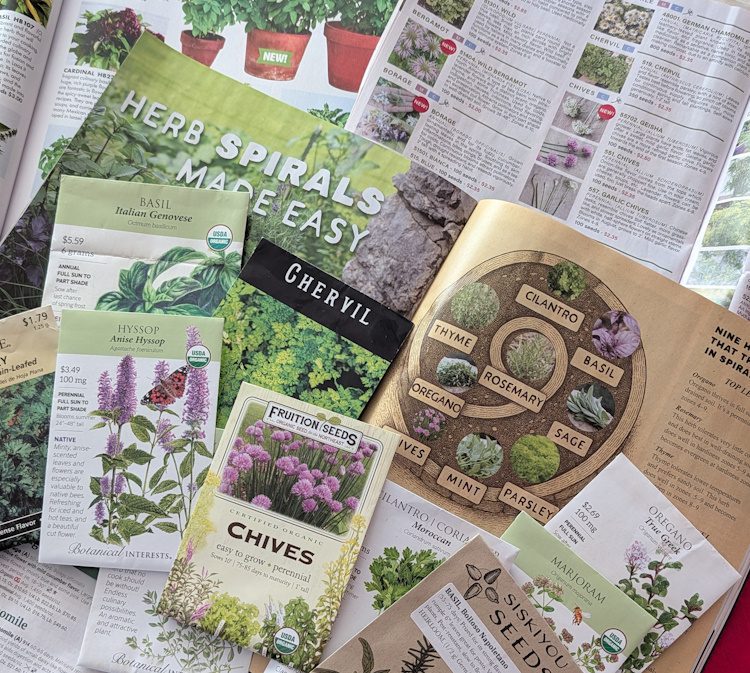
We, on the other hand, face the reality of growing in less-than-ideal conditions, soil, and plant spacing—and frequently, in climates that are not like theirs. It’s best to keep these points in mind while perusing. That said, using seed catalogs for inspiration is an essential part of good garden planning—but it’s just the first step.
The Northern-Climate Reality Check
Our northern growing climate (USDA Zones 5-6) creates seasonal challenges in our gardens, so we have to read seed catalogs a bit differently. This is especially important when considering a variety’s days-to-maturity (DTM). This useful detail can help us choose the best options to grow in our climate.
What does days-to-maturity actually mean? In short, it’s the number of days it takes for the plant to produce a harvest (fruit or flowers) in optimal growing conditions.
Ah, there’s the rub.
The days-to-maturity listed in the catalog don’t account for our cool springs, cold soil, and often-late planting timeline.
Let’s break this down further: we get about 120 frost-free days, usually from mid-May through September. So, does a 110-day winter squash variety have possibilities? Possibilities to grow, yes. Possibilities to produce a harvest? Mm, probably…not.
For better results (including a harvest), I recommend selecting ‘early’ or ‘short season’ cultivars that mature in 90 days or less.

DTM is also essential for seed sowing—both indoors and outdoors. When combined with your last average frost date, it helps determine the best time to plant seeds. Start too early, and the seedlings may struggle in cold soil; start too late, and you risk missing out on a harvest.
Read Between the Lines
Seed catalogs offer a wealth of information in the plant descriptions. But that’s where things can sometimes get a little tricky. Over years of gardening, I’ve learned, through trial and error, how to decode seed catalog language.
Take the word “vigorous.” Sometimes it means healthy and lively… or it can be code for aggressive. A vining tomato with vigorous growth tells me, “You’d better have a strong trellis in place to support this one.”
I’ve mentioned “heat-loving” – if we’re talking about peppers or eggplant, that means the plant will most definitely sulk all through our wet June. You’ll also often see “productive” used, and I firmly believe it translates to: “needs perfect conditions to produce.”
I’m being somewhat tongue-in-cheek here, still, a few essential qualities to look for include short-season or early varieties, cold-tolerant types, and, for success, sticking with reliable performers rather than novelty varieties. Choose plants that match your actual garden, not your fantasy one.
Keep It Regional
Many national seed companies have been in business for centuries: D. Landreth Seed Company was founded in 1784 (still around today); W. Atlee Burpee & Co. was founded in 1876; and a recent newbie (for this list), Johnny’s Selected Seeds, was founded in 1973.
While these companies sell reputable seed, for the most part, they no longer grow, trial, or breed seed in-house. Today, many national companies source seed globally.
There is nothing wrong with that, but you should know that the seeds you purchase may be from a very different climate from the one you grow in.
That’s why many of my favorite seed catalogs are regional. These companies offer products grown in our region; therefore, they are better adapted to our climate and growing conditions.
A few to check out include Snake River Seed Co-Op (Boise), Adaptive Seeds (Oregon), True Leaf Market (Salt Lake), Siskiyou Seeds (Oregon), Irish Eyes (Ellensburg), and Territorial Seeds (Oregon).
When you choose regional seed companies, you support our local seed shed and small farmers and growers.
Build a Smart Garden Plan with Catalogs
It’s easy to feel overwhelmed when browsing seed catalogs. Honestly, how do you pick from 10 pages of tomatoes? Oh, how I understand this struggle.
Here’s a straightforward method to plan your garden while flipping through those glossy pages.
- Before you even open the cover, know your last average frost date. Your entire garden plan is built around this date.
- Know your available space. I tend to forget plant spacing and cram in as much as possible (no bare ground = less weeds, more production). But even this kind of planting has limits—six zucchini will not fit in one 3×6 bed!
- And remember, most vegetables and many flowers need at least 6 hours of sunlight daily.
Next, add some inspiration: choose one or two “fun experiments” like growing something you’ve never grown before (artichokes?) or trying a newly released variety (that’s where those 10 pages of tomatoes come in).
Most of your garden plan should focus on reliable varieties you know will produce—mixing proven performers with a few new varieties. This kind of planning, even while browsing, helps set you up for success instead of overwhelming you.

Dream Boldly—Choose Wisely
Ogling seed catalogs is almost a gardener’s rite of passage. They allow us to dream big—while quietly reminding us to keep one boot planted firmly in reality.
Let them spark ideas, fuel winter optimism, and help you imagine what could grow. Then pair that with a bit of climate wisdom, honest math, and a clear-eyed look at your space. Remember, the best garden isn’t the most exotic—it’s the one that actually produces.
Now, pour yourself another cup, dog-ear those pages with intention, and start penciling in a garden that’s both hopeful and harvestable. Wishing you a bountiful gardening season and a Happy New Year!
If this was helpful, I send out a gardening newsletter once or twice a month with more of the same — straight to your inbox. Get it here: http://eepurl.com/g2QHkj





Leave a Reply