Pssst… Don’t tell anyone, but I’ve got a dirty little secret growing in my greenhouse.
I’m growing genetically modified (GM) tomatoes—six plants, to be exact.
Now that I’ve outed myself, you’re probably asking: Why, Candace? You’re all about heirlooms and open-pollinated varieties. How could you bring such an abominable thing into your greenhouse?

In the name of science, education, and understanding!
Since I teach seed-starting classes and discuss genetically modified organisms (GMOs), it only makes sense that I have firsthand experience.
You see, there is a great deal of confusion— and yes, some fear—surrounding genetically modified plants.
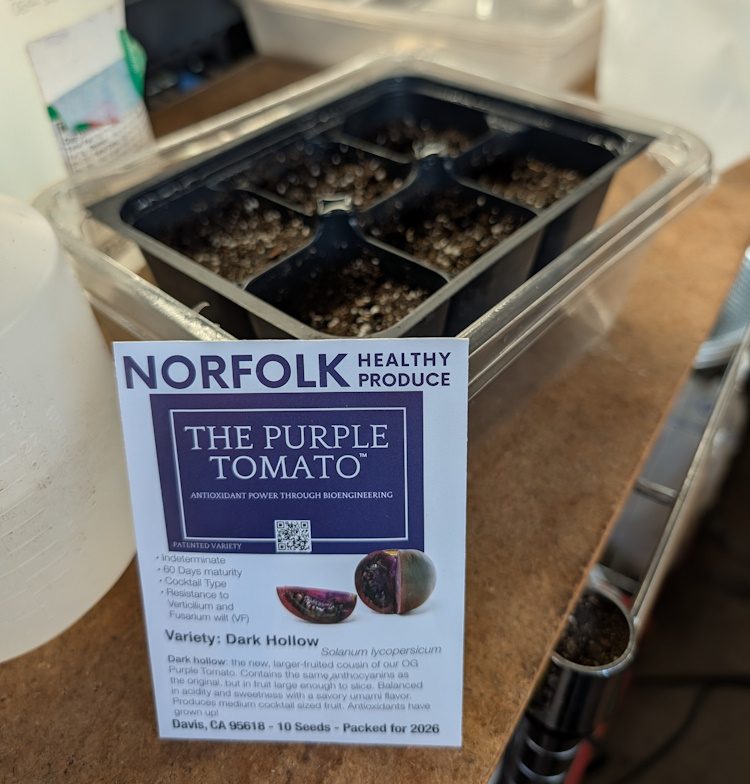
With that in mind, I’ve begun growing the genetically modified ‘Purple Tomato’, a new and unusual addition to the home garden. It’s the first GMO vegetable seed available to home gardeners.
And that raises the question: Do gardeners need to worry about GMO seeds or plants infiltrating their gardens? Let’s take a closer look at what, if anything, warrants concern.
Controversy & Confusion
Here are some notable attributes of GM plants: The Purple Tomato has strikingly fluorescent-purple flesh. Arctic apples don’t turn brown when cut. And many agricultural crops can withstand being sprayed with weed killers.
What kind of science produces these unusual vegetables and fruits? Bioengineering and the creation of genetically modified organisms.
GMOs have sparked considerable controversy and confusion since the 1994 introduction of the first genetically modified food approved for human consumption, the “Flavr Savr” tomato. It was engineered for a longer shelf life but ultimately failed commercially.

Confusion about what a GMO is—and what it isn’t—persists, along with fear that these plants could end up in home gardens (until recently, they generally could not).
Seed companies have reassured gardeners that their seeds are “non-GMO,” using statements on packets, websites, and catalogs.
Yet, in trying to reassure gardeners, the seed industry has inadvertently added to the confusion rather than clarifying it.
GMO Explained in Simple Terms
A genetically modified organism is a plant (or animal) whose genes (DNA) have been altered in a laboratory through bioengineering.
In some cases, genes are transferred within the same species, across species (creating transgenic organisms), and even across kingdoms. Regardless of where the genes originate, a GMO does not occur naturally.
According to the USDA, 14 bioengineered foods are currently available in the United States. Most are commercial field crops, such as corn, soybeans, cotton, and sugar beets.
Are Hybrids the Same as GMOs?
Gardening has many terms, and they often become intertwined when they should not. Such is the case with hybrid plants and seeds, which are often mistaken for GMOs.
Hybrids are not GMOs.
Hybrid (F1) seeds are created through plant breeding where two parent plants of the same species are cross-pollinated. This is done naturally (with human guidance) to produce offspring with specific traits, such as disease resistance, vigor, or uniformity.
Sun Gold, a popular hybrid cherry tomato, was developed through natural cross-pollination of two tomato plants.
Hybrids do not have their genes altered. GMOs have their genes modified in a laboratory.
Why Home Gardeners Rarely Encounter GMO Seeds
Most GMO crops were developed for large-scale commodity agriculture. The seeds are patented, licensed, and highly regulated; farmers must sign contracts before obtaining them.

Simply put, GMO field crops are not sold through home garden seed catalogs. While seed companies advertise “We do not sell GMO seeds,” the reality is that they have never had access to them.
But in recent years, things have changed. Genetically modified seeds are now available to the gardening public.
The GMO Purple Tomato
On February 6, 2024, the first GM vegetable seeds became available to home gardeners. It was, once again, a tomato—a very purple tomato.

Norfolk Healthy Produce created the ‘Purple Tomato’, a bioengineered variety that produces high levels of anthocyanins, antioxidants associated with potential health benefits.
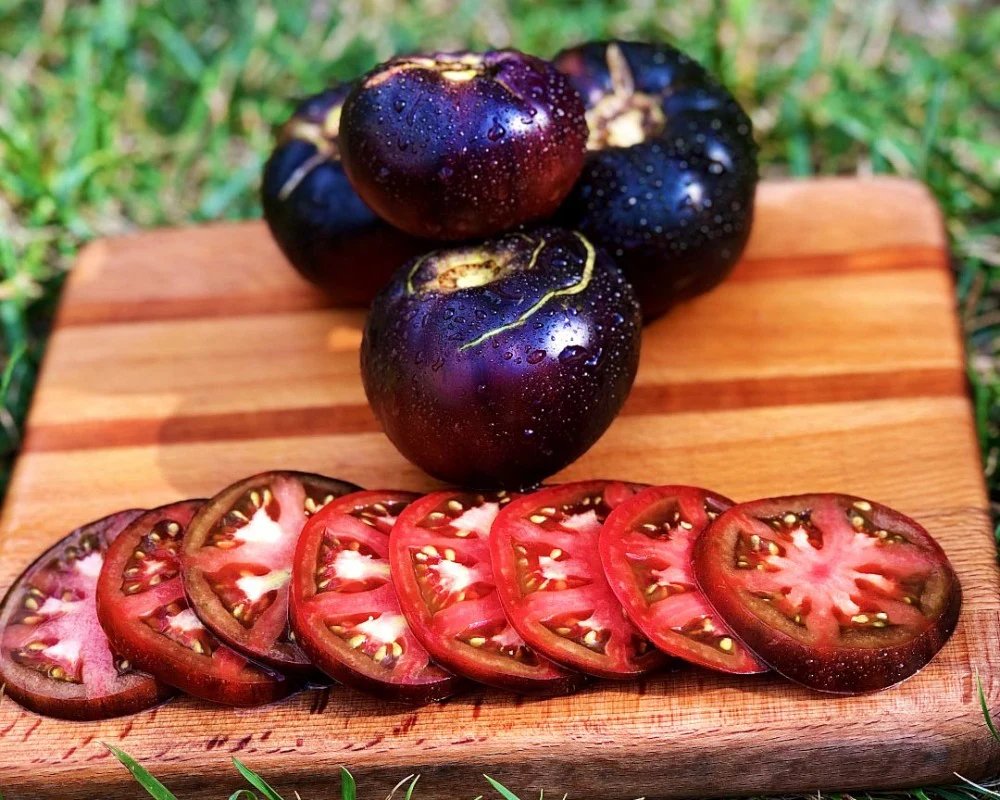
Unlike traditional blue or purple tomatoes that develop pigment primarily in the skin, this tomato is deep purple throughout the flesh.
It is a transgenic GMO, meaning it contains genetic material from another plant species—in this case, snapdragon flowers, which gives it its purple coloring.
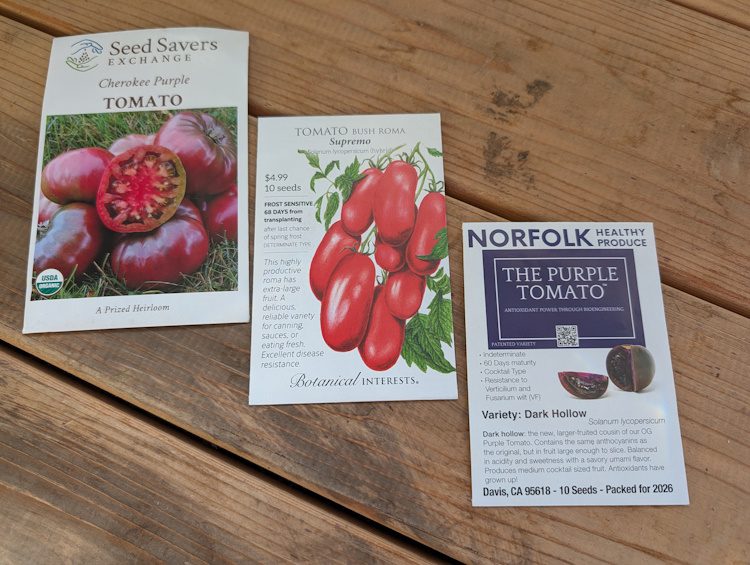
However, anthocyanins are not new to tomatoes. Certain open-pollinated and heirloom varieties naturally develop purple or blue pigmentation. Indigo Rose, Blue Beauty, and Cherokee Purple all contain naturally occurring anthocyanins—no gene splicing required.


Given my love of tomatoes and my curiosity about this variety, I felt the need to part with $15 plus shipping to acquire the 10 Purple Tomato seeds (yes, I counted).
Unlike open-sourced seed, which encourages saving and sharing, GM seeds from Norfolk come with strings attached. By purchasing their seeds, you agree not to sell the seeds, plants, or fruit.
How Does Your Purple Tomato Grow?
My seeds arrived in late February in a fancy lilac-colored envelope, but the seeds themselves looked like any other tomato seed—nothing glowing in the dark.
The seedlings germinated quickly and have grown into healthy, robust plants. They’ve spent the past month in the greenhouse, enduring chilly nights like troopers.

It’s about time to pot them up, as I’ll be growing them in containers, away from my heirloom and open-pollinated varieties.
Why sequester them? They could cross-pollinate with my other tomatoes. According to Norfolk, these plants will breed true, meaning saved seed should produce similar plants.
Still, I’m keeping a little distance—just to be safe.
And the big question? How will the fruit taste? I’ll let you know sometime in August.
Know What You’re Growing—and Why
Understanding the difference between hybrids and GMOs helps replace fear with clarity. For decades, GMO seeds were not accessible to home gardeners, and even now, they remain limited to just a few products.
So should gardeners be worried? Probably not—but they should be informed.
The Purple Tomato may be new and unusual, but it’s also a reminder that the seed world is evolving. As gardeners, our job isn’t to fear every new development—it’s to understand it, ask questions, and decide what belongs in our own gardens.
As for me? I’ll grow my six purple tomatoes, satisfy my curiosity, and return to my tried-and-true Cherokee Purple—because in the end, flavor still wins.
The modern seed world can be complex, but the backyard garden stays beautifully simple: select what aligns with your values, climate, and goals—and grow confidently.




Leave a Reply